
AI features, agents and automation
QBLab builds AI into products where it earns its place — an assistant that answers from your own data, search that understands a sentence instead of a keyword, and automation that removes a step someone does by hand — running on accounts you own, so you control the cost and the data.
Artificial intelligence
Who it's for
- You have a product and a job inside it that a person does by hand every day.
- Your users cannot find what they came for, and a search box has not fixed it.
- You want to know whether AI would actually help your product before you pay to find out.
What's included
Assistants, search and automation, on accounts you own.
- AI features
- Agents
- Process automation
- Intelligent workflows
How an engagement works
The four-week shape is a first release of the scope we agree on the call — the version that is genuinely usable, not the finished product. Bigger products get there in stages, and most keep growing for months afterwards. Your case studies below carry their real timelines.
Day 1
A 30-minute call
You describe the product. We ask the questions that change the estimate, and you leave with a plan and a fixed quote.
Week 1
Plan and design
Scope, screens and data model agreed. You see what will be built before anything is built.
Weeks 2–3
Build
Working software every few days, not a reveal at the end. AI does the fast part; a senior engineer reviews every change.
Week 4
First release
The agreed scope goes live on your accounts and your infrastructure, with the stores and domains pointed at it. Usable by real people, and the starting point rather than the finish line.
Ongoing
Keep building
Month by month: the rest of the roadmap, new features, updates, monitoring and looking after the tech. This is where a first release grows into a complete product. Pause or stop whenever you like.
The work
Both of these are QBLab's own builds, free to click through. The assistants in them are scripted for the demo — they show the product you would get, not a model answering live.
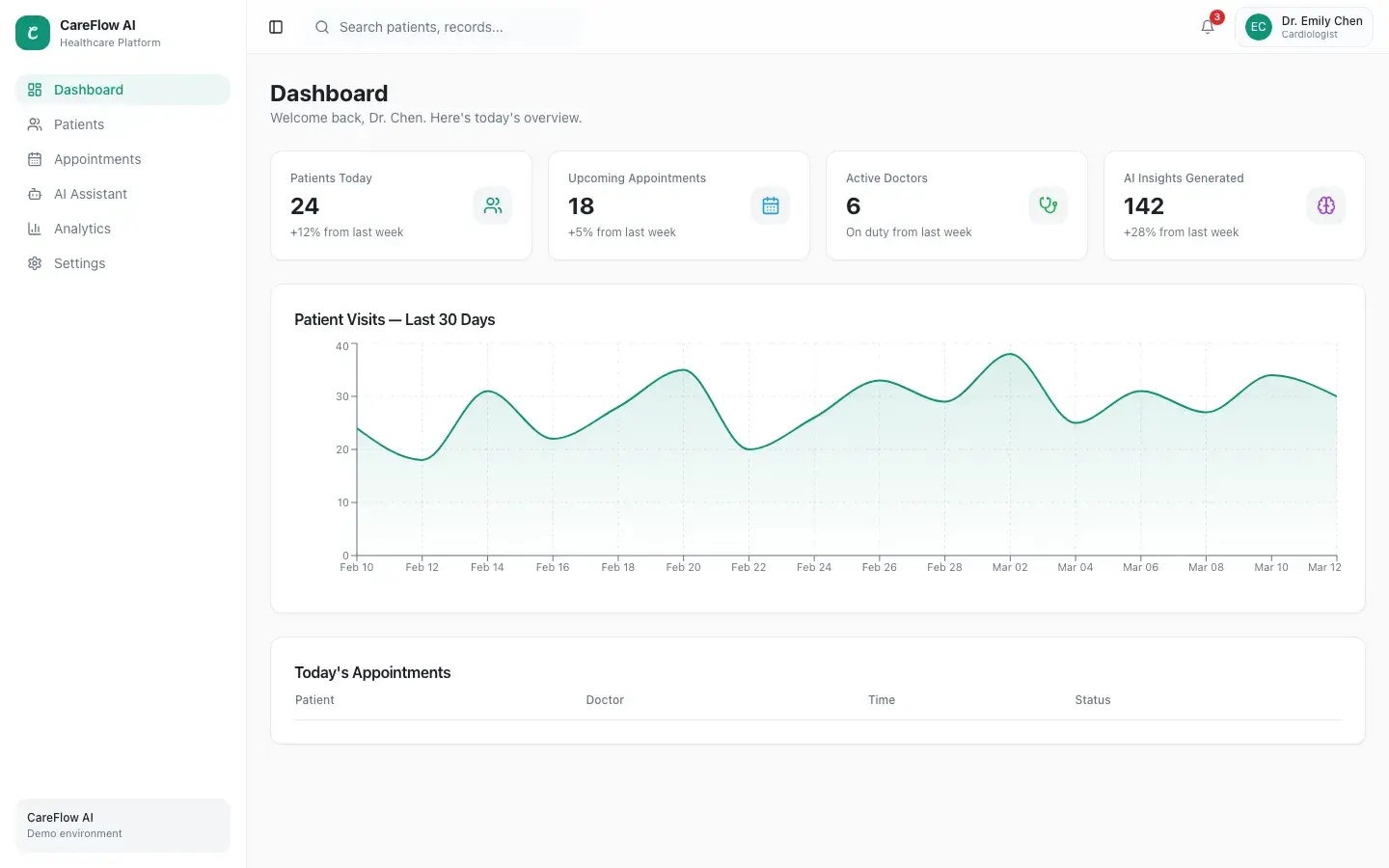
CareFlow
A telehealth platform for clinics: patients, appointments and an AI clinical assistant in one place.
TypeScript · React · Vite · Tailwind CSS

Rimberio
An online store with AI product recommendations and a shopping assistant that helps people find what they came for.
TypeScript · React · Vite · Tailwind CSS
Questions
Whose AI accounts does it run on?
Yours. For building we use our own tools, but anything the product itself does with AI runs on accounts in your name, so you see the bill, you set the limits, and your data stays under your control.
What will you tell me not to build?
Anything where the AI is the feature rather than the point. If a rule, a filter or a better form does the job, we will say so on the call — an assistant bolted onto a product nobody uses is an expensive way to not fix the product.
Can you add AI to a product that already exists?
Yes, and it is the common case. We read what is there, find the one step that is costing you time, and ship that first rather than rebuilding the product around a feature neither of us has tested yet.
How do you stop it from making things up?
By keeping it answering from your own content rather than from memory, showing the source with the answer, and keeping a person in the loop wherever being wrong is expensive. A senior engineer reviews every change before it ships, the same as any other work.